Children often follow the same educational and career paths as their parents. While this may seem natural, it can limit social mobility, reinforce inequality, and prevent talent from being allocated efficiently. In developing countries, where parents may have limited education and labor market information, these constraints can be particularly severe.
A recent IZA Discussion Paper by Sofia Badini, Esther Gehrke, Friederike Lenel and Claudia Schupp, which is forthcoming in the Journal of Human Capital, examines whether personalized digital career guidance can help students broaden their horizons and make more informed educational and occupational choices. Testing a mobile application in rural Cambodia, the study finds that a simple app-based intervention encouraging self-reflection significantly increases engagement with career information and expands the range of occupations students consider.
Narrow aspirations in a changing economy
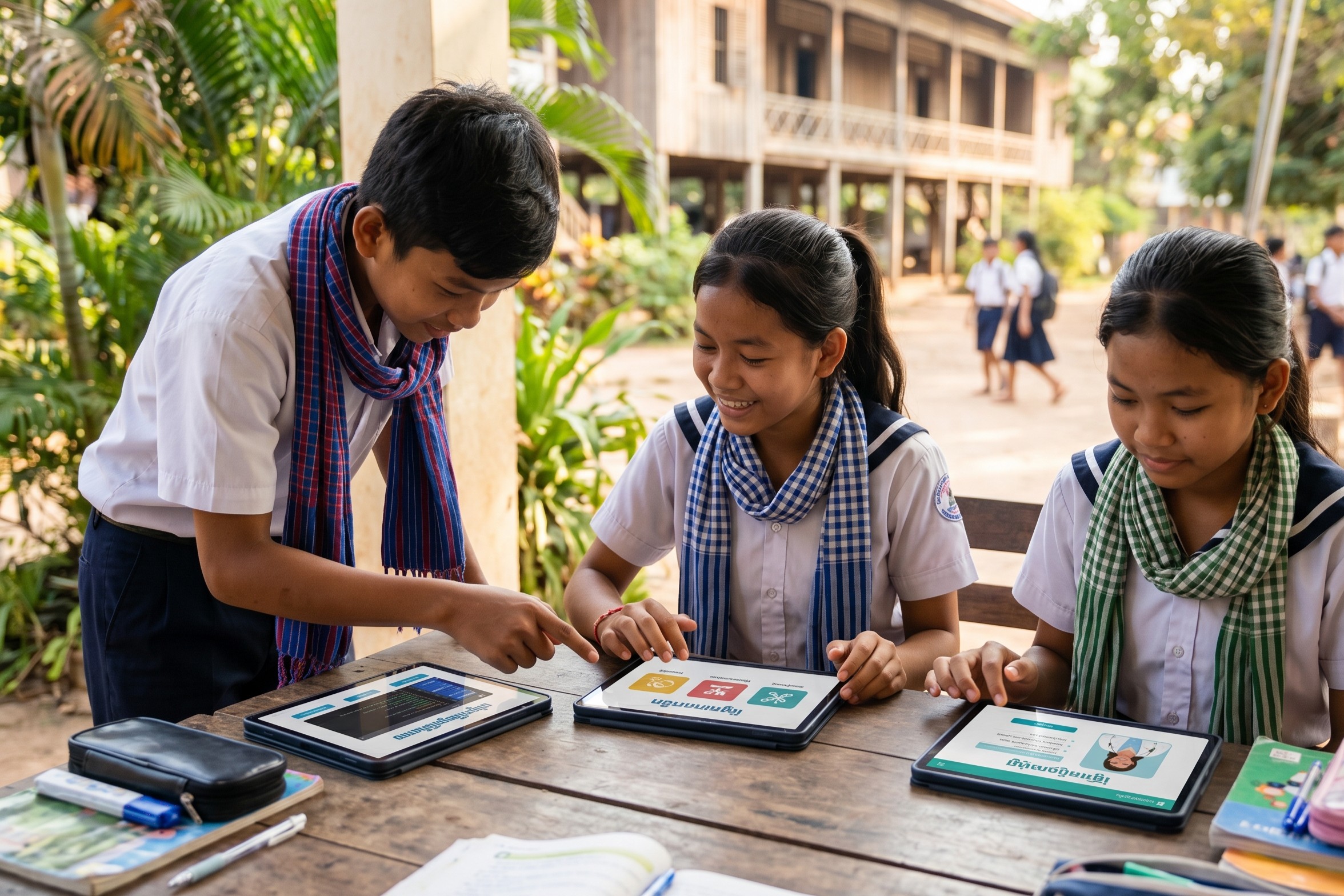
The study focused on ninth-grade students in rural Cambodia, a critical juncture where students face important decisions about their future education and careers at the end of compulsory schooling.
This context presents a unique challenge: rapid educational expansion means many parents have substantially less education than their children and cannot provide effective career guidance. As a result, student aspirations are heavily bottlenecked. Before the intervention, more than 85% of students aspired to just three careers—doctor, teacher, or police officer—and many held inaccurate beliefs about the required educational paths.
At the same time, Cambodia faces growing mismatches between education and labor market demand, with increasing demand for vocational skills alongside rising unemployment among university graduates.
Testing personalized career guidance
To address these challenges, the researchers developed a low-cost mobile application designed to personalize career information.
The application architecture works through two distinct phases. First, the app asks students to reflect on their own interests and preferences. Second, it recommends careers that align with those interests, helping students connect information about occupations to their own identities and aspirations.
To measure the true impact of personalization, the study compared these users with a control group using a similar app. This version provided the exact same career information but presented occupations in a random order without tailored recommendations.
Greater exploration and broader career interests
The findings show that personalization substantially changes how students engage with career information. Students using the personalized app read more career descriptions, spent more time exploring unfamiliar occupations, and expressed interest in a wider range of careers. They were also more likely to consider occupations requiring less formal education, including pathways accessible right after high school rather than university.
A striking takeaway is that part of this effect emerges even before students receive personalized recommendations. Simply prompting students to reflect on their interests encourages them to engage more actively with information and explore options they might otherwise overlook.
Implications for educational decision-making
A common concern is that personalized guidance could discourage disadvantaged students from pursuing higher education. The study finds no evidence of such effects. Instead, lower-performing students become more interested in careers requiring less education, suggesting that the intervention helps them identify pathways that better match their abilities.
More broadly, the findings show that students often focus on familiar or prestigious occupations while overlooking alternatives. By combining self-reflection with personalized information, low-cost digital guidance can broaden students' perspectives and support better-informed educational and career choices.
Download the full paper here.