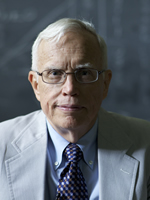


James J. Heckman is the Henry Shultz Distinguished Service Professor of Economics and Public Policy and Director of the Center for the Economics of Human Development at the University of Chicago. Heckman has a B.A. (1965) in Mathematics from Colorado College and an M.A. (1968) and Ph.D. (1971) in Economics from Princeton University. He has been at the Department of Economics at the University of Chicago since 1973. He was one of the founders of the Harris School of Public Policy, where he also has an appointment. Since 1991, he has been a research fellow at the American Bar Foundation. In 2010, he cofounded the Human Capital and Economic Opportunity Global Working Group, a global network of over 400 scholars working on aspects of measuring and addressing problems of inequality and economic opportunity. In May, 2014, he launched the Center for the Economics of Human Development at the University of Chicago.
He has devoted his professional life to understanding the origins of major social and economic questions related to inequality, social mobility, discrimination, the formation of skills and regulation in labor markets, and to devising and applying economically interpretable empirical strategies for understanding and addressing these questions. While his research is rooted in economics, he also actively collaborates across disciplines to examine all aspects of major problems. His recent interdisciplinary research on human development and skill formation over the life cycle draws on economics, psychology, genetics, epidemiology, neuroscience, and law to examine the origins of inequality, the determinants of social mobility, and the links among stages of the life cycle, starting in the womb. This work has influenced both the scholarly literature and public policy.
In 2000, Heckman won the Nobel Prize in Economics for his work on the microeconometrics of diversity and heterogeneity and for establishing a sound causal basis for public policy evaluation. He has received numerous other awards for his work, including the John Bates Clark Medal of the American Economic Association in 1983, the Jacob Mincer Award for Lifetime Achievement in 2005 from the Society of Labor Economics, the 2005 and 2007 Dennis Aigner Award for Applied Econometrics from the Journal of Econometrics, the Ulysses Medal from the University College Dublin in 2006, the 2007 Theodore W. Schultz Award from the American Agricultural Economics Association, the Gold Medal of the President of the Italian Republic, awarded by the International Scientific Committee of the Pio Manzú Centre in 2008, the Distinguished Contributions to Public Policy for Children Award from the Society for Research in Child Development in 2009, and the Frisch Medal from the Econometric Society in 2014 for the most outstanding paper in applied economics published in Econometrica in the previous five years. He is a recent recipient of a NIH MERIT award.
Heckman is a member of the National Academy of Sciences, USA; a member of the American Philosophical Society; a fellow of the American Academy of Arts and Sciences; the American Association for the Advancement of Science; the Econometric Society; the Society of Labor Economics; the American Statistical Association; the International Statistical Institute; and the National Academy of Education. He has received numerous honorary degrees, and is a foreign member of several scholarly bodies.
James J. Heckman joined IZA as a Research Fellow in September 1999.
In 2000, he was co-winner of the Nobel Prize in Economics for his development of theory and methods for analyzing selective samples [read more].

